





Welcome back to “A Look Back at ECN Tradeshow History.” This month, the archives trace an industry moving through recovery, expansion, leadership change, and global uncertainty. From the return of live meetings and the women who helped companies adapt during the pandemic to major convention center projects, association transitions, labor planning, and Brexit concerns, these stories capture the people and decisions shaping the tradeshow business across decades. Got your own memory to share? Email Mark at Markh@exhibitcitynews.com. We would love to include it in a future edition.
Five Years Ago
July 2021
The Wonderful Women of Willwork
Willwork recognized 11 women whose leadership and adaptability helped the company navigate the COVID-19 shutdown and prepare for the return of live events. The feature highlighted Denise Franzen, Lisa Studley, Sarah Fantauzzi, Dee Peters, Anita Bota, Maureen Jardlin, Stephanie Latzanakis, Danielle Clark, Noelle Webster, Shannon Cushing, and Kaitlyn Kewriga. As tradeshows paused, they took on new responsibilities spanning virtual events, retail installations, health and safety compliance, information technology, client services, marketing, finance, and operations. The story celebrated the teamwork and resilience that kept Willwork serving clients while positioning the company for the industry’s recovery.
WEC MPI in Las Vegas—A True Celebration
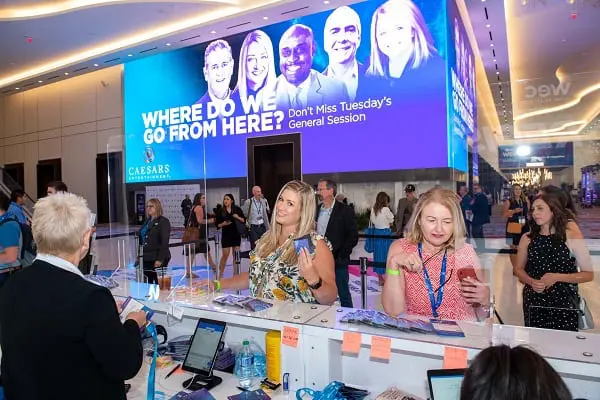
Meeting Professionals International (MPI) held its World Education Congress at the newly opened Caesars Forum in Las Vegas. The event welcomed nearly 1,300 in-person attendees and almost 600 digital participants. It marked a major return to live meetings after the COVID-19 shutdowns. Programming included education, networking, wellness resources, and events at Allegiant Stadium and the Venetian. MPI also highlighted the support it provided during the pandemic, including online education, mental health resources, and more than $1 million in grants and scholarships through the MPI Foundation.
International Meetings Statistics Report
The Union of International Associations (UIA) released its 62nd International Meetings Statistics Report, comparing activity before and during the COVID-19 pandemic. The report presented full data from 2019, described as the last strong year before the crisis, alongside an analysis of 2020. UIA said international association meetings had typically totaled 12,000 to 15,000 annually, but the number recorded for 2020 dropped sharply as travel restrictions and limits on public gatherings disrupted events worldwide. The report also included a 20-year view of meeting trends from 2001 through 2020.
Ten Years Ago
July 2016
Los Angeles Convention Center Wins 2016 Venue Excellence Award
The Los Angeles Convention Center (LACC) received the International Association of Venue Managers’ 2016 Venue Excellence Award during the VenueConnect conference in Minneapolis. The award recognized the center’s work in operations, customer service, sustainability, safety, staff development, and community service. LACC had recently achieved Leadership in Energy and Environmental Design (LEED) Gold recertification and expanded its guest services and security programs. AEG Facilities, which managed the venue, also reported operational savings and the creation of a multimillion-dollar financial reserve for the City of Los Angeles.
EDPA Enters a New Era
The Exhibit Designers and Producers Association (EDPA) entered a new management phase after Access Intelligence closed its association management division. Executive Director Jeff Provost responded by launching PRO Management LLC, which assumed responsibility for EDPA’s daily operations. Provost said the transition aimed to preserve continuity while supporting membership growth, financial stability, education, awards, and the association’s annual ACCESS conference. He also expanded the staff to strengthen membership recruitment and member services as EDPA adapted to changes across the exhibit design and production community.
Uncertainty Follows Affirmative “Brexit” Vote
Fifteen Years Ago
July 2011
CEIR president asks if we are a troubled industry
Douglas L. Ducate, president and chief executive officer of the Center for Exhibition Industry Research (CEIR), released a white paper defending the exhibition industry’s business practices. The paper responded to Chicago news reports that questioned pricing, exclusive contracts, and customer treatment. Ducate argued that the industry did not have a flawed business model. Instead, he said its practices reflected common market principles, including preferred treatment for major customers, the cost of entering a market, and pricing shaped by supply, demand, and competition. The paper represented Ducate’s views and not an official CEIR position.
University of Houston honors convention center legend
The University of Houston’s Conrad N. Hilton College of Hotel and Restaurant Management established the Jimmie Dee Fore Scholarship Endowment to support students pursuing careers in convention, meetings, and facility management. Fore spent 42 years in the exhibition industry and held leadership roles at the Greater Houston Convention and Visitors Bureau, New Orleans Convention and Visitors Bureau, McCormick Place, and the Ernest N. Morial Convention Center. After Hurricane Katrina, he helped lead the convention center’s cleanup and $60 million renovation. The Conrad N. Hilton Foundation agreed to match contributions to the scholarship endowment.
Twenty Years Ago
July 2006
Nomadic Display names 2 VPs
Twenty-Five Years Ago
July 2001
McCormick Place gets OK to expand
The Illinois Legislature approved an $800 million expansion of McCormick Place that would add more than 800,000 square feet to the Chicago convention complex. Plans for McCormick Place West included 610,000 square feet of exhibit space, 140,000 square feet of meeting space, and a 60,000-square-foot ballroom. The project aimed to help the venue attract more small and midsize tradeshows and meetings. Financing would come from an extension of existing taxes used for earlier construction. The plan still required approval from Illinois Gov. George Ryan.
Mandalay Bay breaks ground
Mandalay Bay broke ground on its planned 1.8 million-square-foot convention center, with construction scheduled for completion in summer 2002. The project included more than 1 million square feet of exhibit space, a 100,000-square-foot pillarless ballroom, multiple loading docks, business services, and direct access to Mandalay Bay Resort Group hotels. Company officials said the expansion would strengthen Las Vegas’ ability to attract national and international tradeshows while giving planners greater flexibility through connected lodging and meeting facilities. At opening, the center was expected to become the largest convention facility on the Las Vegas Strip.
LVCVA organizes labor group meeting
The Las Vegas Convention and Visitors Authority (LVCVA) organized a task force of organizers, labor unions, contractors, and facility representatives to address workforce needs as the city’s convention space approached 9.3 million square feet. Representatives from the Teamsters, International Alliance of Theatrical Stage Employees (IATSE), show management companies, and trade associations met to discuss labor availability, training, and work rules ahead of continued expansion. The group aimed to ensure Las Vegas could support growing convention demand while maintaining a qualified workforce and adapting to customer expectations as new exhibit and meeting space came online.
ESCA approves name, bylaw changes
The Exhibition Services and Contractors Association (ESCA) approved a new name and revised bylaws to reflect the changing exhibit and event industry. The updates expanded membership eligibility to include consultants, exhibit managers, trade associations, organizers, and independent exhibit producers, while labor organizations received their own membership category. ESCA leaders said the changes better represented the industry’s growing range of service providers and encouraged broader participation. The association also approved two-year Board terms and added a president-elect position as part of its governance changes.